Oidis Labs
The ERP our own company runs on
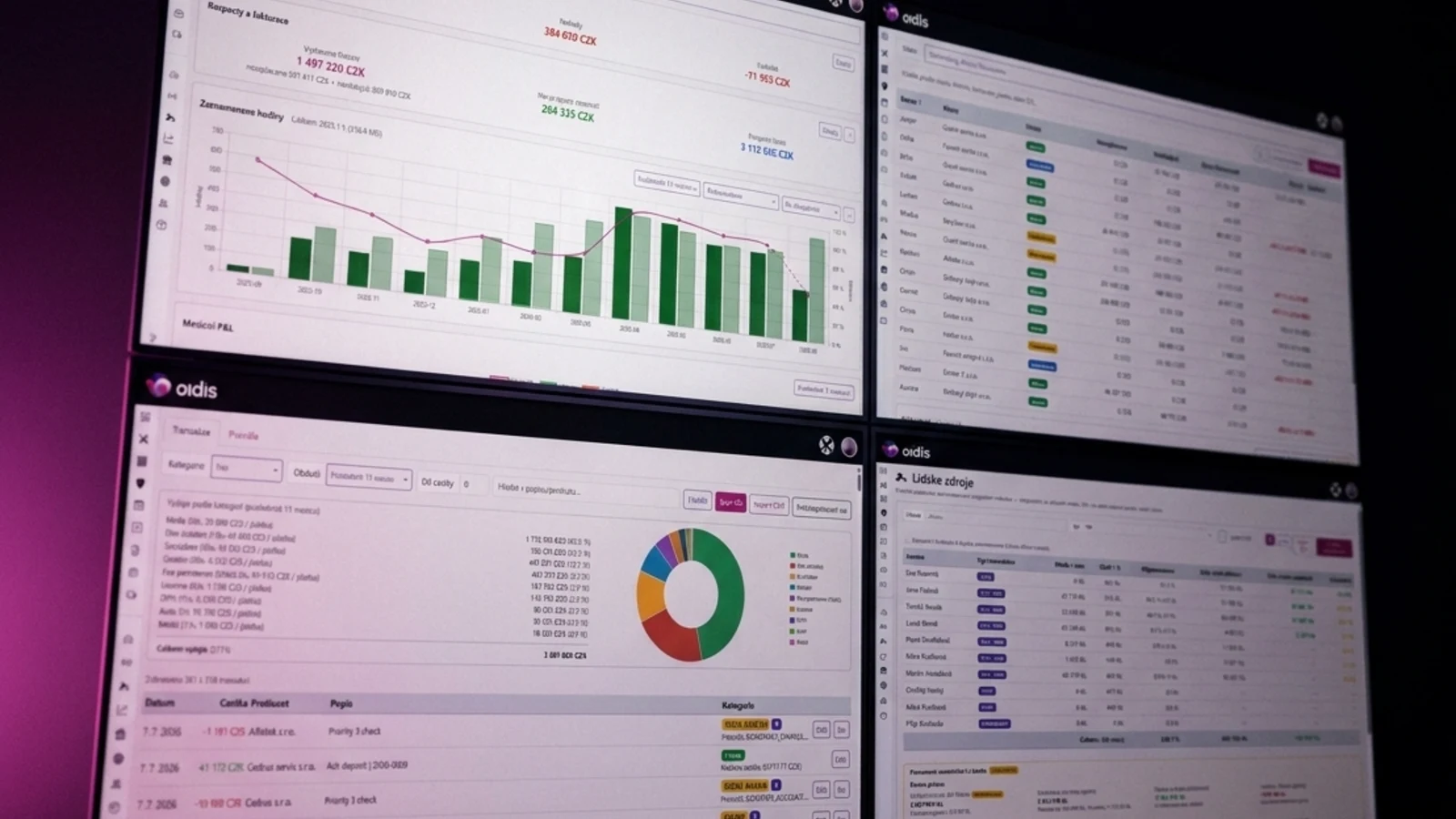
Before the tools we build reach clients, we use them ourselves. Oidis Labs is our own company portal — it holds projects and budgets, finance and cashflow, invoicing groundwork, attendance, HR, the vehicle logbook, documents with electronic signatures, a register of companies and domains, inventory and the search for new opportunities, all in one place. It runs on the same framework as our client applications, so whatever proves itself here reaches clients next.
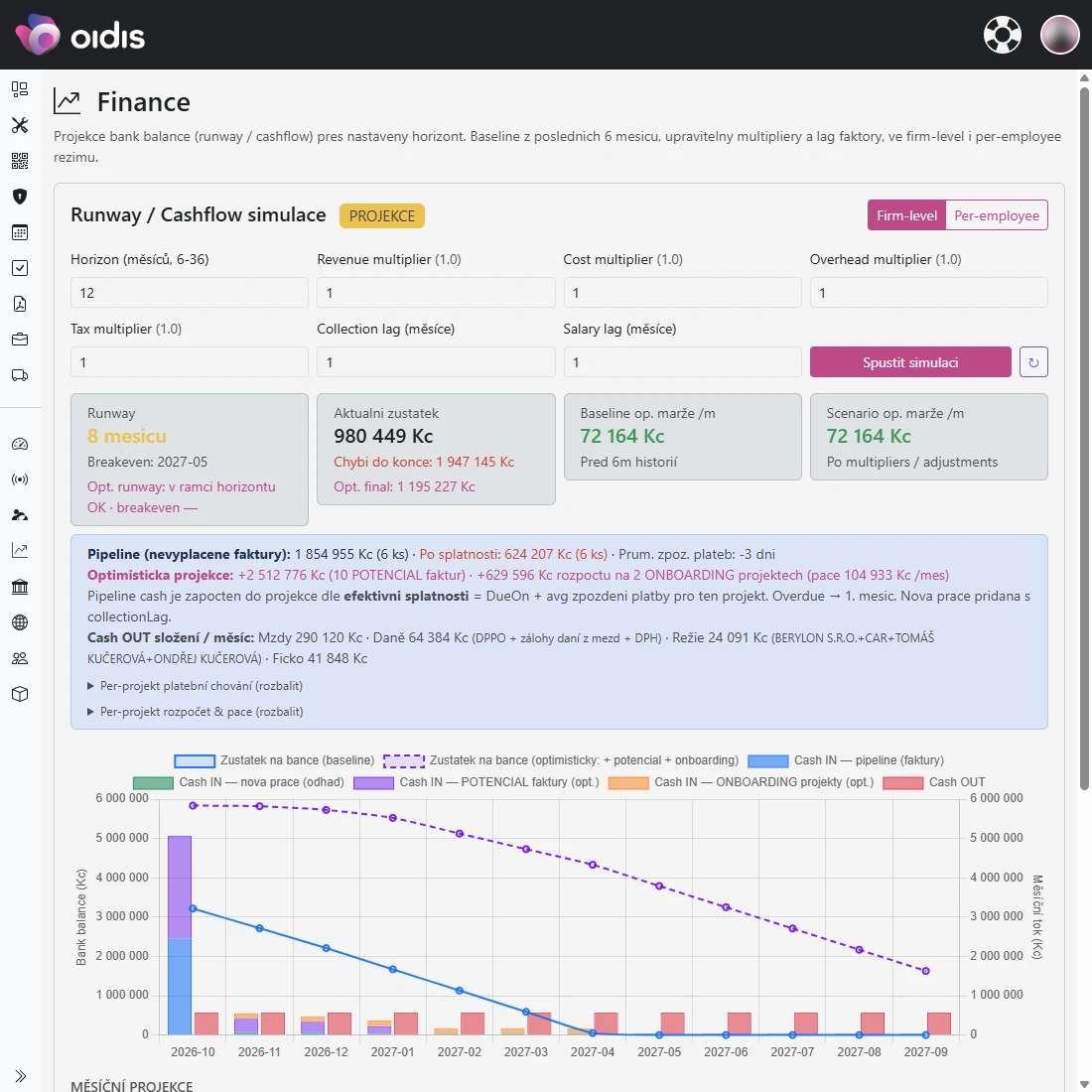
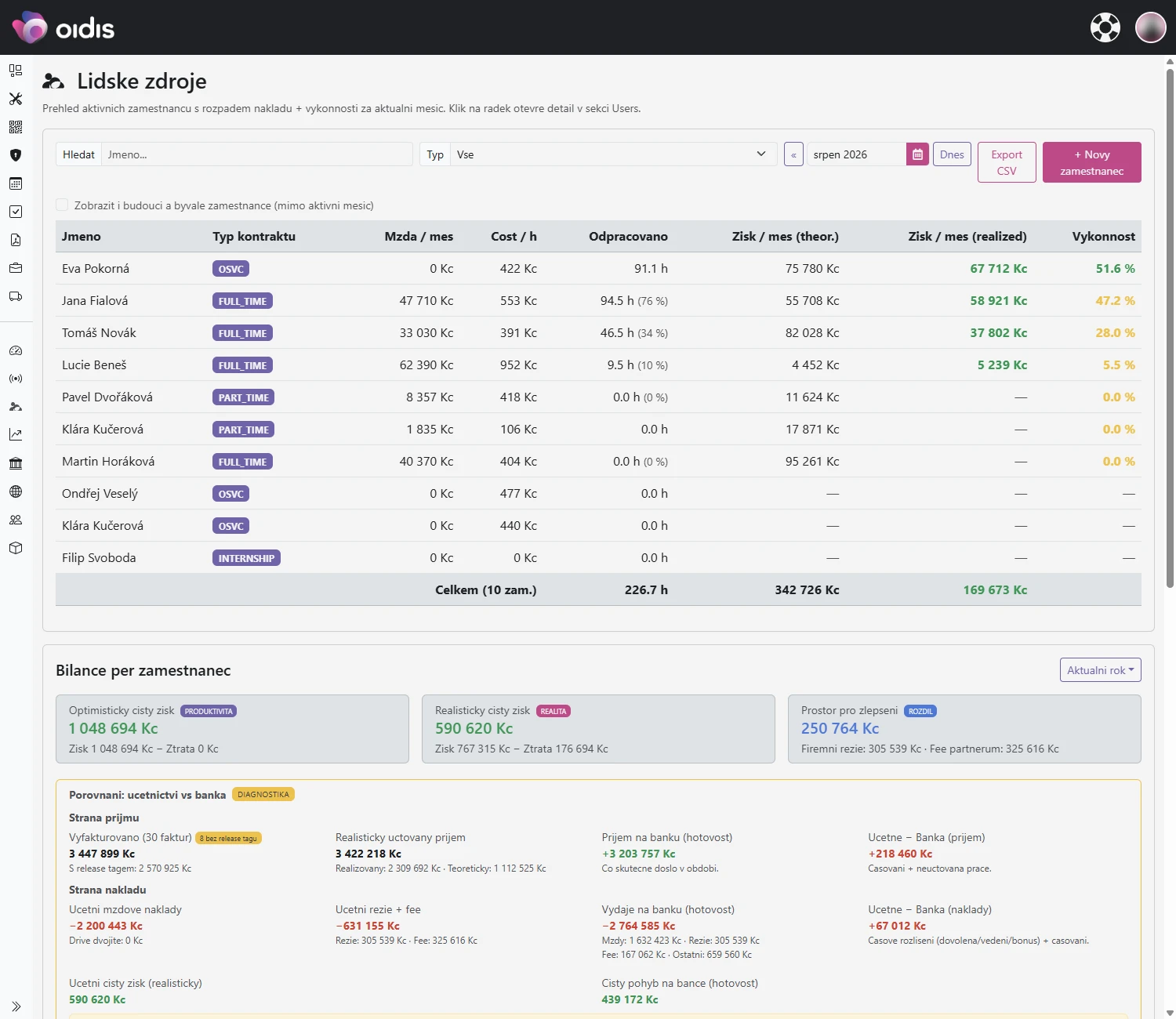
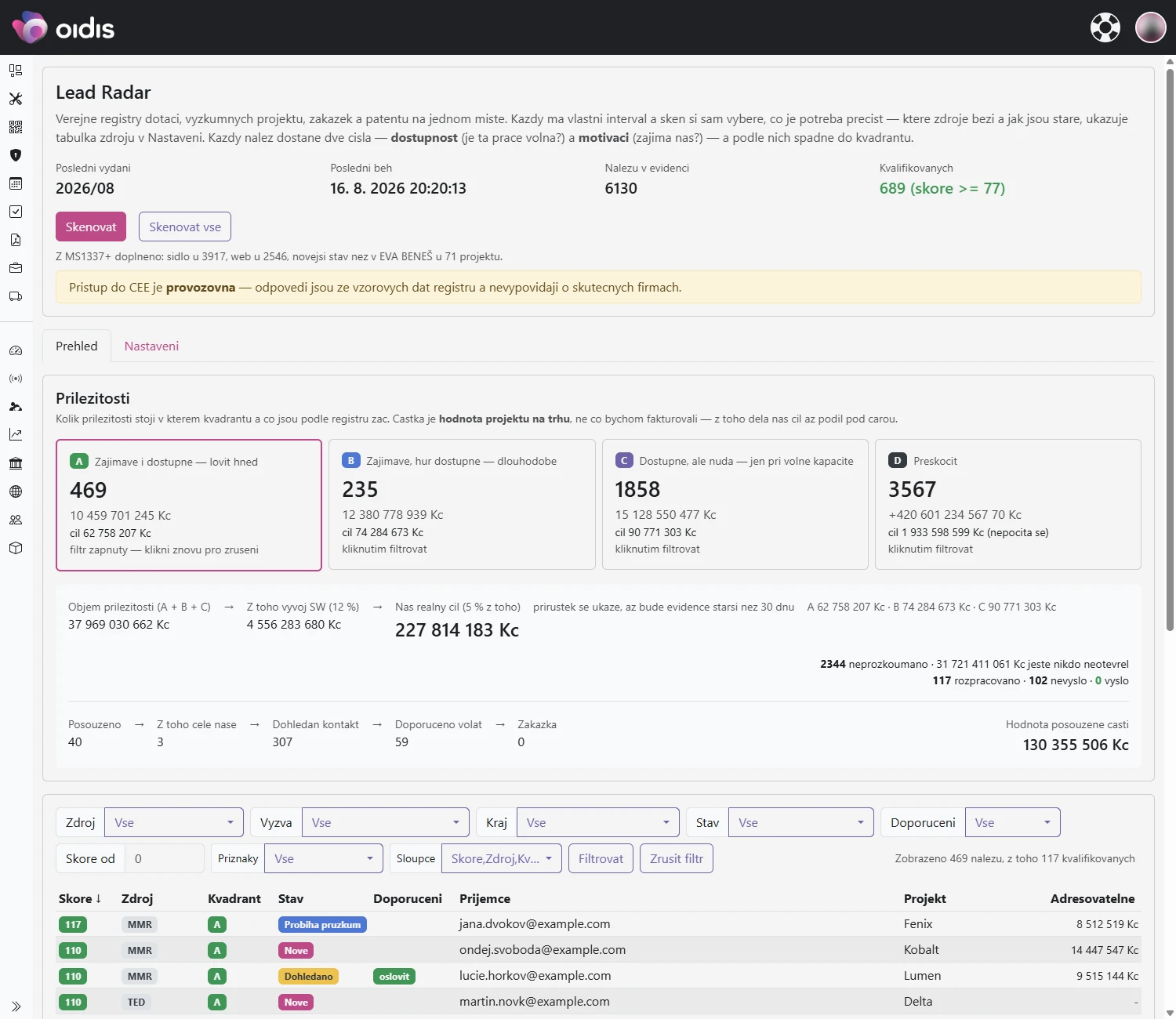
The landing screen is the company overview: the result for a chosen period, issued invoices and unspent budgets, hours worked against utilisation, and movements on the account. From there you move into some fifteen modules. Projects show what is left to invoice on each engagement, how many hours remain in the budget and how the margin works out, along with a register of the technical essentials — domains, repositories, infrastructure. Finance simulates runway and cashflow months ahead. Human resources works out cost per hour, performance and the balance between the books and the bank. Documents are written in Markdown, rendered to PDF, and can be signed electronically or circulated for policy acknowledgement. Add attendance with a monthly report for the accountant, a vehicle logbook with maps and travel orders, inventory, domain and DNS management, a company register with screening in public registries, and Lead Radar for acquisition. What each person sees is governed by permissions — the administrative modules are for administrators only.


Technology
We developed the platform on the Oidis Framework in TypeScript — a frontend of framework components, a Node.js backend with Oidis Hub, GraphQL and a MongoDB database, all running in Docker. The banking integration uses an Open Banking API with mutual TLS, OAuth2 and qualified certificates; onboarding runs through SAML SSO on the bank's own hosted page. Invoicing, project and knowledge tools, source control and Microsoft 365 are reached through their APIs, and domains through registrar interfaces, Cloudflare and RDAP. Maps in the logbook are built on Leaflet over OpenStreetMap, documents are written in the Monaco editor with Mermaid diagrams and rendered to PDF. Sign-in is by e-mail, Google or Microsoft Entra with two-factor authentication. An MCP server with its own consent screen sits on top of the data for questions from AI assistants.
The brief
A company our size usually lives in five tools that don't talk to each other. Projects in spreadsheets, timesheets in another system, online banking on its own, attendance somewhere else — and at the end of the month the accountant collects the paperwork from everywhere. Any number telling you how the company is actually doing then arrives late, and only after manual reconciliation. We wanted a single source of truth — and at the same time to prove our own framework on an application we use every day and that must not go down.
The solution
We built the platform on the Oidis Framework and connected it to the systems where company data actually originates: the bank, invoicing, project and knowledge tools, Microsoft 365, domain registrars, DNS and public registries. Data is therefore pulled rather than retyped — bank movements over a secured connection (mutual TLS, OAuth2 and qualified certificates), with a set of rules sorting them straight into the categories that make up the cost breakdown. The project and personnel side builds on the same data, so hours worked, budgets, invoicing and actual movements on the account all show the same picture. From the work delivered, the application assembles its own statement as the groundwork for an invoice. An MCP server sits on top of the data with its own consent screen, so we can ask questions about the company straight from an AI assistant — have a margin calculated, discrepancies in invoicing checked, or an opportunity scan started. And because we build on a framework we develop ourselves, every capability in Labs feeds back into the products we build for clients.
Key features
- company overview: period result, budgets, invoicing, hours worked and utilisation
- projects: remaining budget, margin, worklogs from the project tool and a register of technical essentials
- finance: runway and cashflow simulation, pipeline of unpaid invoices, plan of upcoming invoices
- an automatic statement of work delivered as the groundwork for invoicing, broken down by release
- bank: movements imported through the banking API or a statement, rule-based categorisation, payroll matching
- invoicing checks: duplicates, unconfirmed card holds, hours that would otherwise be lost
- attendance with a monthly PDF report sent to the accountant and a record of what was sent
- human resources: cost per hour, performance, contracts, employee card and change audit
- vehicle logbook with maps, fuel consumption, travel orders and an export for the accountant
- documents from Markdown to PDF — templates, diagrams, sharing, SharePoint
- electronic signing of documents and records of policy acknowledgement
- company register by registration number with screening in public and paid registries
- domain and DNS management: expiry, registrars, Cloudflare, zone backups
- Lead Radar: grants, research projects, public tenders and patents, with scoring
- inventory of company equipment linked both to an employee and to the purchase record
- secure handover of a password through a protected archive and a second password by SMS
- sign-in by e-mail, Google or Microsoft, with two-factor authentication
- global search across modules and an MCP server for questions from an AI assistant
Results & benefits
- a single source of truth about finance, projects and people — with no manual reconciliation
- twenty releases since the end of 2024, the latest additions arriving every two to three weeks
- runway and cashflow can be simulated before the cost is committed to
- invoicing groundwork and accountant reports assemble themselves from data already in the system
- Lead Radar processes tens of thousands of public-registry records and sifts dozens of opportunities out of them
- proof of our own framework on an application we use daily and that must not go down